About this Honey
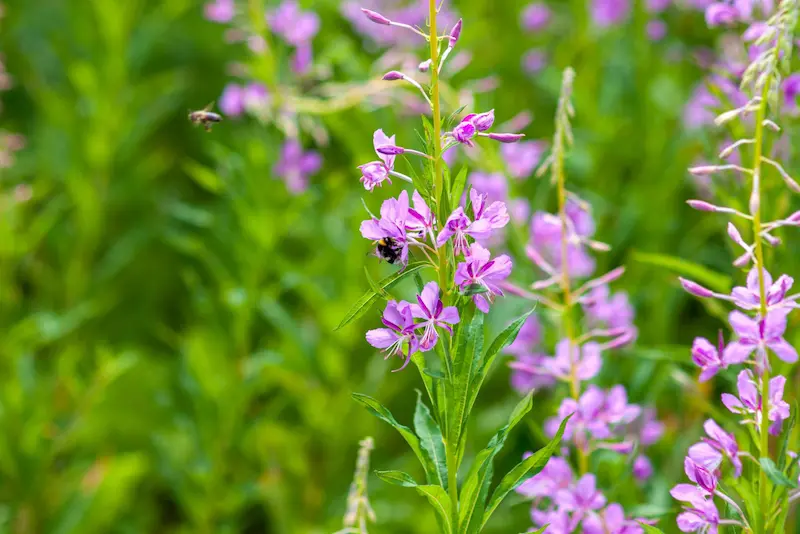
Native to the Pacific Northwest, Canada, and Alaska, harvested in late summer. The plant is a "pioneer species" that grows aggressively in burned-over areas. The honey is known as the "Champagne of Honeys" for its water-white color, smooth texture, and delicate, tea-like flavor. It is a premium varietal that is increasingly rare due to habitat changes.
Honey Characteristics
Chamaenerion angustifolium
Summer
Rare
Alaska & Pacific NW
Ethereal, faint raspberry bush, clean alpine air, delicate sweet grass
Velvety, water-smooth, medium viscosity, crystalline-resistant
Honey Profile Chart
Scale: 1 (Low) → 5 (High)
The Story
Chamaenerion angustifolium is a classic pioneer species whose prolific nectar secretion depends entirely on historic forest fire disturbances and high-altitude summer sun. Honey bees face the challenge of navigating the long, vertical racemes of the fireweed plant, which mature from the bottom upward, requiring precise, daily adjustments to foraging heights within short, volatile alpine blooming windows. Fireweed honey exhibits a remarkably low moisture profile combined with an elevated fructose content, yielding a water-white clarity and an exceptionally smooth, velvety medium viscosity. Its neutral pH and delicate chemical structure mean it burns easily under high heat, making it unsuited for baking but an elite raw asset for delicate, low-acid culinary pairings like raw berries or white needle teas.
Sensory Profile
Tap a note to highlight it. These are the defining sensory characteristics of Fireweed Honey.
Where Fireweed Honey is Produced
Highlighted states are known sources of Fireweed honey. Click a state to explore local apiaries.
Culinary Applications
Best Pairings
Foods and drinks that bring out the best in Fireweed Honey.
Similar Honeys to Try
Can't find Fireweed Honey? These varieties share similar characteristics.
Apiaries with Fireweed honey
Local apiaries offering this honey variety. Support your local beekeepers!
At a Glance
A Rare variety, harvested in Summer, from Alaska & Pacific NW, derived from Chamaenerion angustifolium blossoms.