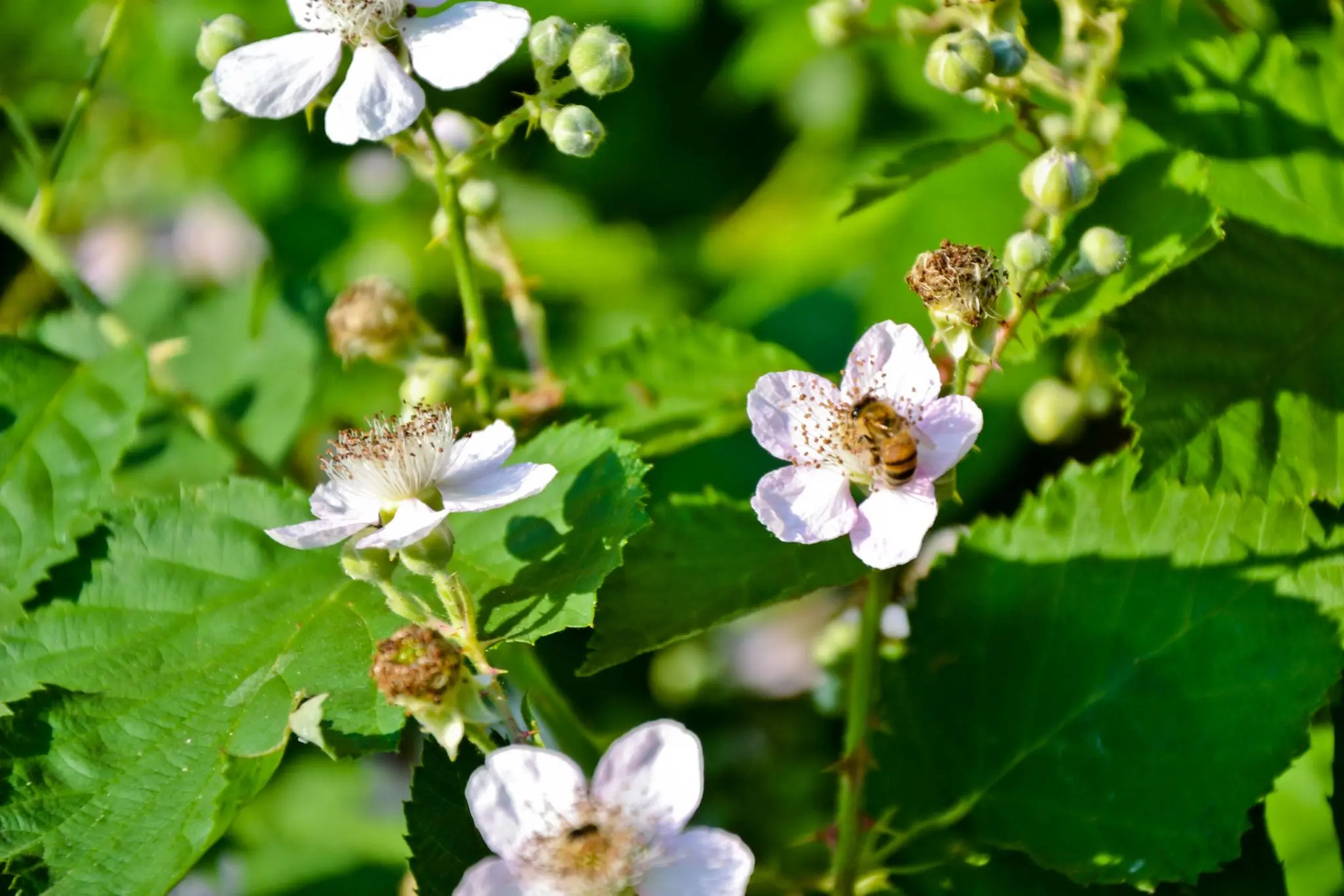
About this Honey
Gathered from the wild brambles of the Pacific Northwest and the Appalachian mountains during early summer. This honey is typically light to medium amber and captures the essence of the berry patch. It offers a rich, smooth texture with a fruity, rounded flavor profile. It is considered a "thick" honey and pairs exceptionally well with strong cheeses like Stilton.
Honey Characteristics
Rubus fruticosus
Summer
Common
Universal / Pacific NW & SE
Rich berry preserves, faint cedar wood, dark bramble musk
Luxuriously thick, slow-pouring heavy body with an elegant mouthfeel
Honey Profile Chart
Scale: 1 (Low) → 5 (High)
The Story
The foraging mechanics of pure Rubus fruticosus demand precise timing across the Pacific Northwest and Appalachian valleys, where heavy spring rains must be followed by immediate early summer heat to unlock the deep nectar wells. Honey bees efficiently exploit the open, multi-stamen architecture of the blossom, completing massive storage cycles before late-summer droughts dry out the briar root systems. Characterized by a low moisture-retention profile and high density, this varietal demonstrates maximum viscosity and structural resistance to crystallization. Its high molecular weight and complex tannin traces allow it to withstand high-heat applications, making it an excellent glazing agent that binds to dense animal proteins and animal fats without breaking down into simple sugars.
Sensory Profile
Tap a note to highlight it. These are the defining sensory characteristics of Blackberry Honey.
Where Blackberry Honey is Produced
Highlighted states are known sources of Blackberry honey. Click a state to explore local apiaries.
Culinary Applications
Best Pairings
Foods and drinks that bring out the best in Blackberry Honey.
Similar Honeys to Try
Can't find Blackberry Honey? These varieties share similar characteristics.
Apiaries with Blackberry honey
Local apiaries offering this honey variety. Support your local beekeepers!
At a Glance
A Common variety, harvested in Summer, from Universal / Pacific NW & SE, derived from Rubus fruticosus blossoms.