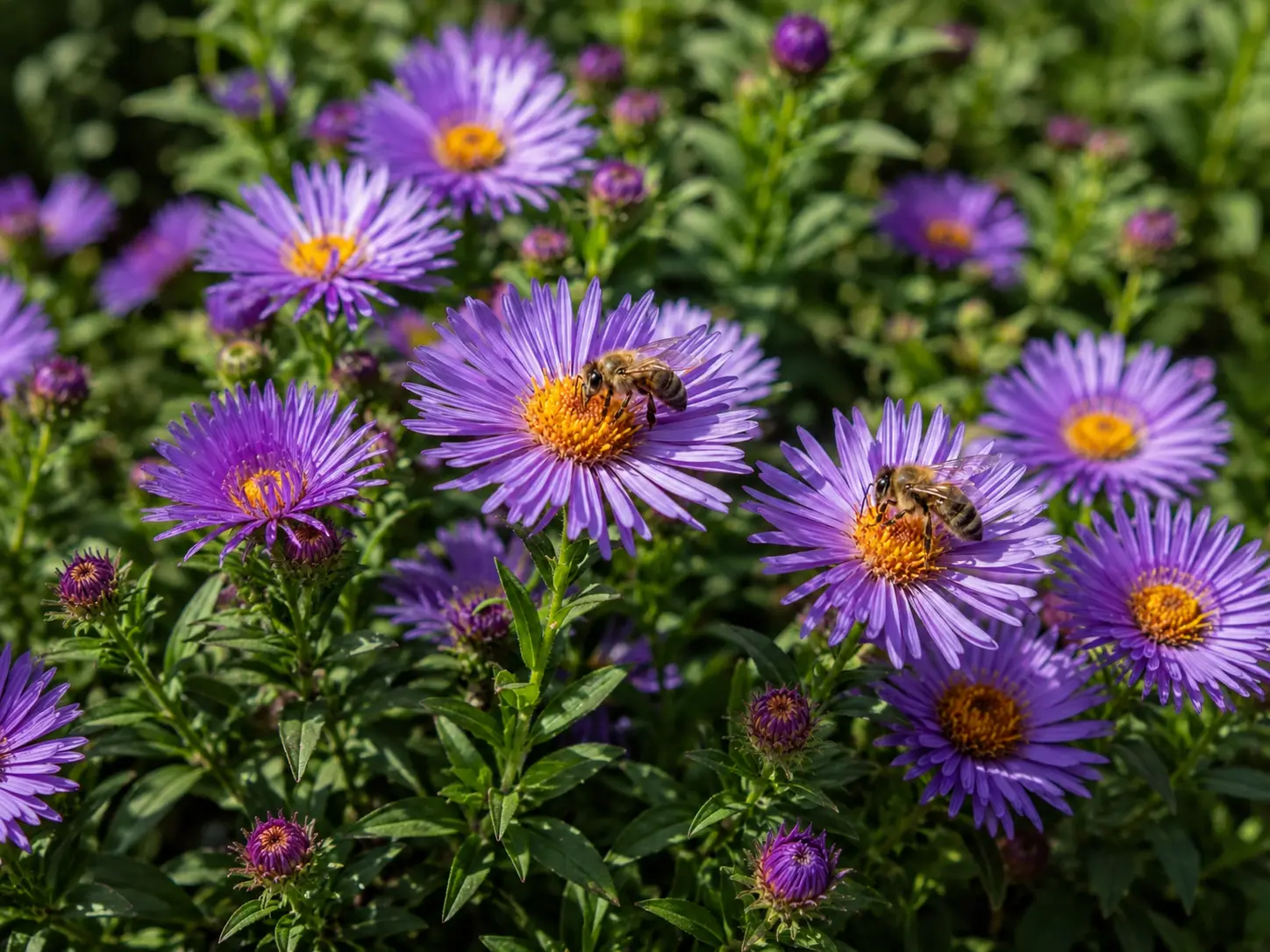
About this Honey
Harvested in late autumn across the U.S., often alongside Goldenrod. Aster honey is distinctive for its rapid crystallization—it can solidify in the comb within days if not extracted. It is very light in color (water white) and has a distinctively sweet, floral, and slightly pungent aroma. Connoisseurs prize it for its candy-like smoothness when creamed.
Honey Characteristics
Symphyotrichum
Fall
Common
Central & Eastern US
Intense sugary perfume, sharp fall blooms, pungent candied field clover
Aggressively fast-setting, turning into a rock-hard solid block inside days
Honey Profile Chart
Scale: 1 (Low) → 5 (High)
The Story
Symphyotrichum represents the absolute final nectar corridor of the north-central foraging season, erupting across open fields just as colonial populations begin clustering for winter. Honey bees work these shallow florets with extreme urgency under decreasing daylight hours, capturing a high-sucrose, low-moisture nectar before early frosts kill off the remaining vegetation. The exceptional glucose saturation triggers an aggressive, rapid crystallization sequence that can solidify the raw honey directly within the comb within days of harvest. This rapid formation creates a highly sought-after, smooth micro-crystalline structure, making it the premier natural raw material for mechanics of cold-whipped creamed honey spreads without requiring artificial seeding.
Sensory Profile
Tap a note to highlight it. These are the defining sensory characteristics of Aster Honey.
Where Aster Honey is Produced
Highlighted states are known sources of Aster honey. Click a state to explore local apiaries.
Culinary Applications
Best Pairings
Foods and drinks that bring out the best in Aster Honey.
Apiaries with Aster honey
Local apiaries offering this honey variety. Support your local beekeepers!
No Local Sources Yet
We haven't found any apiaries listing Aster nearby just yet. Check back soon as our directory grows!
At a Glance
A Common variety, harvested in Fall, from Central & Eastern US, derived from Symphyotrichum blossoms.