Acacia Honey and Blood Sugar: What the Research Actually Says
Acacia honey is sold as the diabetic-friendly honey, usually with a glycemic index of 32. That number is unsourced — here is what has actually been measured.


Search for acacia honey and the same number turns up again and again: a glycemic index of 32, roughly half that of table sugar. It appears on retailer pages, in buying guides, and on product labels. It does not appear in the peer-reviewed literature.
That does not make acacia honey a fraud. Its sugar chemistry really is unusual, and there is a reasonable scientific case that it sits at the gentler end of the honey range. But the case is narrower and messier than the marketing suggests — and if you are managing blood sugar, the difference between those two things matters.
What acacia honey actually is
Despite the name, acacia honey has nothing to do with true acacia trees. It comes from the blossoms of the black locust, Robinia pseudoacacia — a North American tree now grown widely across Central and Eastern Europe. Hungary is the largest commercial producer, with meaningful volumes out of Romania, Bulgaria, Serbia and Italy.
The honey is pale to nearly water-clear, mild enough to disappear into tea, and unusually slow to crystallize. It sits at the opposite end of the spectrum from something like buckwheat honey, which is nearly black and tastes of molasses. That pale colour is not a sign of purity or quality — it is simply what the black locust nectar produces.
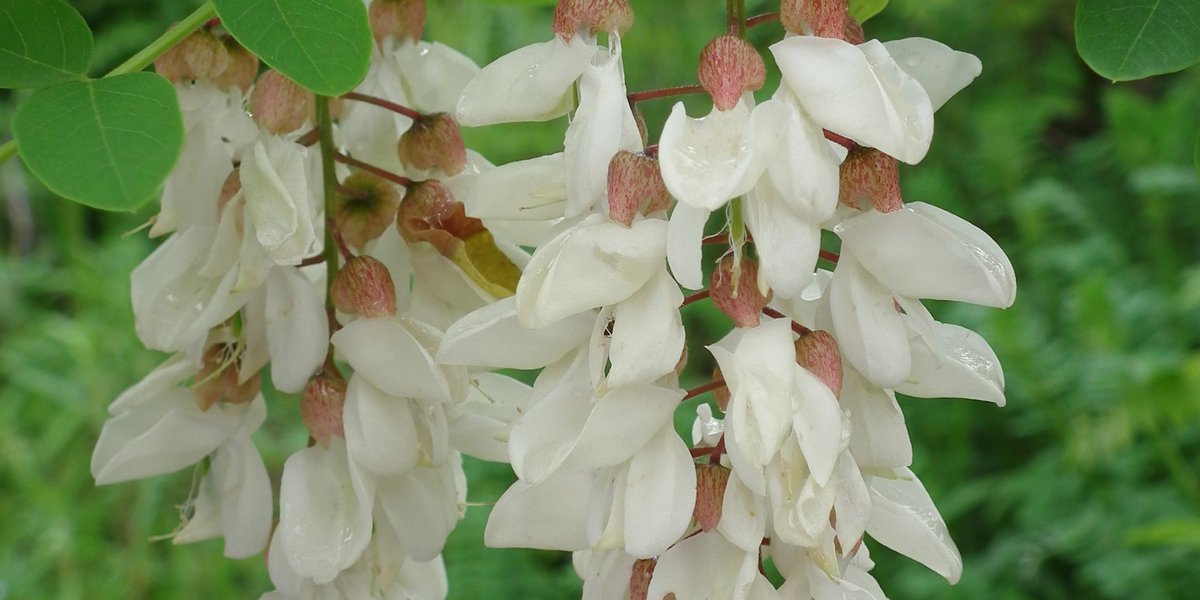
Black locust (Robinia pseudoacacia) in bloom. Despite the trade name, this — not any true acacia — is where acacia honey comes from. Photo: Cbaile19, CC0.
The sugar chemistry is genuinely unusual
Acacia is one of the highest-fructose monofloral honeys on the market — roughly 37% fructose by weight, against noticeably less glucose. Most honeys sit far closer to a one-to-one balance between the two.
That imbalance is why the jar stays liquid. Crystallization starts when glucose drops out of solution and seeds crystals; acacia has comparatively little glucose to do the seeding, so it can stay clear for a year or more while a clover honey beside it turns solid. We go deeper into that process in our guide to storing honey and why it crystallizes.
It is also the entire basis of the low-GI claim. Pure fructose has a glycemic index of just 15 ± 4, far below glucose, because it is metabolized in the liver rather than moving straight into the bloodstream (International Tables of Glycemic Index, Diabetes Care). More fructose, the reasoning goes, means a gentler curve.
What has actually been measured
| Sweetener | Measured glycemic index | Source |
|---|---|---|
| Glucose | 100 | Reference standard, by definition |
| Fructose | 15 ± 4 | International Tables of GI, Diabetes Care 2008 |
| Honey (pooled, all types) | 61 ± 3 | International Tables of GI, Diabetes Care 2008 |
| Sucrose (table sugar) | 65 ± 4 | International Tables of GI, Diabetes Care 2008 |
| Clover honey | 69.2 | US honeys trial, J Am Diet Assoc 2006 |
| Tupelo honey (high fructose) | 74.1 | US honeys trial, J Am Diet Assoc 2006 |
| Acacia honey | No published value found | — |
Two things stand out. The gap between honey at 61 and table sugar at 65 is far smaller than most people assume, and the error bars overlap. And the widely quoted figure of 32 for acacia has no measured study behind it that we could locate — it appears to circulate between retailers citing one another.
Glycemic index is the wrong number anyway
Here is the part almost nobody covers. Glycemic index describes how fast 50 grams of carbohydrate from a food raises blood glucose. Nobody eats 50 grams of carbohydrate worth of honey — that would be about three tablespoons. What actually matters is glycemic load, which accounts for how much carbohydrate is in a realistic serving.
The formula is simple: glycemic load = glycemic index × grams of carbohydrate per serving ÷ 100. A load of 10 or under is considered low, 11 to 19 medium, 20 and above high. Running the numbers for honey against table sugar produces a result that cuts against the marketing.
| Serving | Carbohydrate | Glycemic index | Glycemic load |
|---|---|---|---|
| Honey, 1 teaspoon (7 g) | 5.8 g | 61 | 3.5 — low |
| Table sugar, 1 teaspoon (4.2 g) | 4.2 g | 65 | 2.7 — low |
| Honey, 1 tablespoon (21 g) | 17.3 g | 61 | 10.6 — low/medium |
| Table sugar, 1 tablespoon (12.6 g) | 12.6 g | 65 | 8.2 — low |
Spoon for spoon, honey carries a higher glycemic load than table sugar — not a lower one. Honey is denser and packs more carbohydrate into the same spoon, and that outweighs its slightly lower glycemic index. Carbohydrate figures from USDA FoodData Central; honey is 82.4% carbohydrate by weight, against 100% for granulated sugar.
This is the number to hold on to. Even if acacia turns out to sit at the low end of the honey range, you are swapping one spoonful of sugar for a slightly larger one. The good news is that both land in low territory at teaspoon scale — a teaspoon of honey in tea is a small event for most people. A tablespoon drizzled over yogurt is a different conversation.
Does high fructose actually lower the glycemic response?
The evidence points both ways
The case for
A German trial tested eight honey varieties and found that both glycemic and insulinaemic index correlated significantly with fructose content. Five of the eight came in under 55 — the conventional threshold for a low-GI food.
Those authors went further, suggesting that specific honey varieties may be preferable to sucrose for people with impaired glucose tolerance. That is a real, peer-reviewed statement in acacia’s favour.
The case against
A US trial tested four honeys spanning fructose-to-glucose ratios from 1.03 to 1.54 and found no significant difference between them. All four landed between 69.2 and 74.1 — above table sugar.
Tupelo, at a ratio of 1.54 and nearly as fructose-heavy as acacia, scored the highest of the four. The authors concluded that small differences in fructose-to-glucose ratio do not substantially affect honey’s glycemic index.
Both are legitimate studies. The honest summary is that fructose content plausibly matters, but not reliably enough to promise anyone a number — and no one has published a measured glycemic index for acacia honey specifically.
What this means if you are watching your blood sugar
Acacia honey is still sugar. A tablespoon carries roughly 17 grams of carbohydrate, and whatever its glycemic index turns out to be, it has to be counted like any other added sugar.
Mayo Clinic puts it plainly: "Generally, there’s no advantage to substituting honey for sugar in a diabetes eating plan." (Mayo Clinic)
So the practical guidance does not change. If you like the flavour, use it, count the carbohydrate, and watch how your own numbers respond — individual glycemic responses vary considerably more than any published average. Decisions about your diet belong with you and your clinician or dietitian; nothing here is medical advice.
If blood sugar is your only concern, honey is not the answer
It is worth saying plainly, because most articles on this topic will not. If your single goal is to sweeten something without moving blood glucose, the honest answer is a non-nutritive sweetener — stevia, monk fruit, allulose or erythritol. They contribute essentially no available carbohydrate, so their glycemic load is effectively zero. No honey competes with that, and no amount of fructose chemistry changes it.
The case for acacia honey is a case about flavour, provenance and enjoyment, not metabolism. That is a perfectly good case. It is just a different one from the one the marketing usually makes.
How to buy acacia honey that is actually acacia
Acacia commands a premium, and its mild, hard-to-place flavour makes adulteration difficult to detect by taste. That combination has made it one of the most frequently cut honeys on the market — enough that it has generated its own body of authentication research, with laboratories developing metabolomic and isotope methods specifically to catch acacia diluted with rice or beet syrup.
Adulteration is not only a value problem. Honey cut with cheap glucose syrup will behave differently in your bloodstream than the honey described in this article — which makes provenance a practical concern, not just an ethical one, for anyone buying with blood sugar in mind.
What to look for
Ask for the bloom and the region. A genuine producer can tell you the season the honey was taken and where the hives stood. Vague country-of-origin blends on a supermarket label tell you nothing.
Expect it to stay liquid. Genuine acacia resists crystallizing for a year or more. If a jar sold as acacia sets hard within a few months, its glucose content is higher than acacia should be.
Buy closer to the source. Honey bought directly from a beekeeper carries a traceable story in a way that a repackaged import does not — and it is usually raw rather than pasteurized, which is a separate question worth understanding.
Where acacia honey genuinely earns its price
Strip away the blood-sugar marketing and there is still a good product underneath — the reasons are just culinary rather than clinical.
It stays liquid
No warming the jar, no scraping crystallized honey off a spoon. For anyone who keeps honey on the table rather than in a cupboard, this alone is worth something.
It is the neutral sweetener
Mild and floral enough to sweeten tea, coffee, yogurt or a delicate sponge without stamping honey flavour over everything. It is the honey to reach for when you want sweetness without a point of view — our guide to cooking with honey covers where that matters and where a bolder varietal serves you better.
Acacia Honey and Blood Sugar: Common Questions
Blood Sugar and Glycemic Index
Buying and Storing
Sources
International Tables of Glycemic Index and Glycemic Load Values: 2008 — Diabetes Care. Pooled values for honey, sucrose and fructose.
US honeys varying in glucose and fructose content elicit similar glycemic indexes — Journal of the American Dietetic Association, 2006.
Glycaemic and insulinaemic properties of some German honey varieties — European Journal of Clinical Nutrition, 2009.
Diabetes foods: Can I substitute honey for sugar? — Mayo Clinic.
USDA FoodData Central — carbohydrate values used in the glycemic load calculations.